
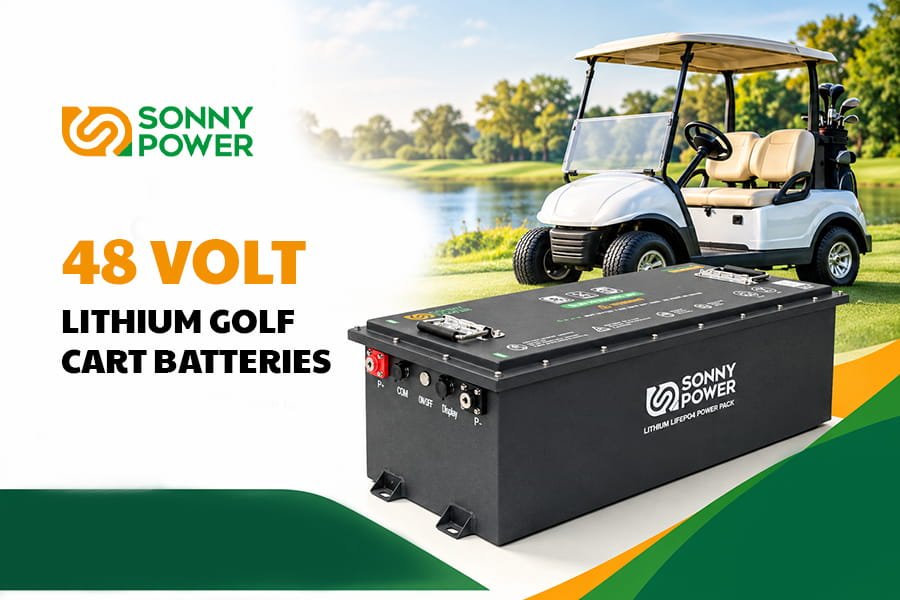
If you drive a golf cart every week, you’re well aware of the ritual. You top off the water, scrub the corrosion off the terminals, and hope the pack gets through one more season. That’s why more owners are switching to lithium golf cart batteries. They’re considerably lighter, hold their charge far better, and need virtually no maintenance at all. This guide covers how they work, what a 48V system is like, what you can expect to pay, and how to choose one without having to guess.
What are Lithium Golf Cart Batteries and How Do They Work?
The vast majority of lithium golf cart batteries on the market today are LiFePO4 (lithium iron phosphate) batteries. That’s the same chemistry you’ll find in solar storage and RV applications. They’re popular for good reason- they’re very stable, they last a long time, and they don’t get hot under normal operating conditions.
A lead-acid pack is a stack of heavy blocks full of liquid and lead plates. A lithium pack is a sealed unit with the cells, the wiring, and a BMS all inside. The BMS is the bit that people often miss. It monitors the voltage, current, and temperature, and will switch the pack off before anything gets pushed too far.
You’ll see the difference on the course. The lead-acid cart slows right down as the charge goes down, particularly on the hills. The lithium maintains a very steady voltage right down to the end, so the cart pulls the same at 20% as it does at 90%. The weight is also a massive difference. Six 8V lead-acid batteries can easily come in at 400lbs; a similar lithium pack will be well under half that weight.
Why Choose 48 Volt Lithium Golf Cart Batteries?
Most modern carts from E-Z-GO, Club Car, and Yamaha run on a 48V system, which is why 48 volt lithium golf cart batteries are the most common upgrade right now. The jump from lead-acid is easy to feel.
Lead-acid packs will typically get you a few hundred to around a thousand charge cycles. Quality LiFePO4 cells are usually rated at 3,000 cycles or so. In practice, that can mean 8 to 10 years of regular use rather than 4 or 5.
You use far more of what you pay for. Lead-acid shouldn’t be drained much below 50% without significantly shortening its life. Lithium, on the other hand, lets you use pretty much all of its rated capacity, so a 100Ah lithium pack will often outperform a lead-acid pack of the same rating.
Charging is faster and cleaner. There’s no watering, no acid fumes, and no need to sit overnight to charge fully. A bit of a top-up between rounds makes no difference to the cells. Performance stays right. Hills, headwinds, and a full cart of passengers don’t seem to have much more effect, since the pack voltage doesn’t drop off at all.
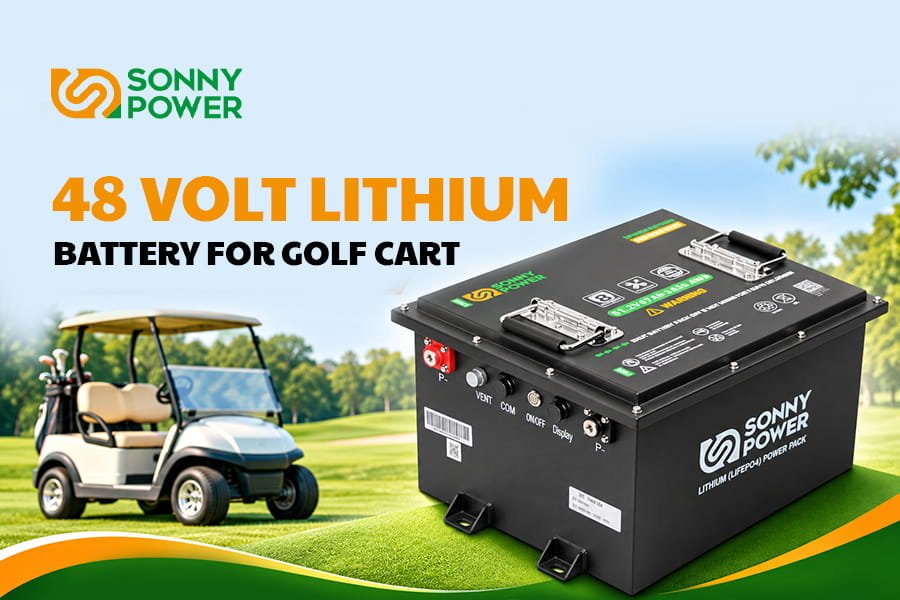
How to Choose the Right 48 Volt Lithium Battery for Golf Cart Use
Not every 48 volt lithium battery for golf cart use is built the same, so a few checks are worth making before you order.
- Voltage: Ensure the pack voltage matches your requirements. Either 6 x 8v or 4 x 12v batteries will give 48v.
- Capacity (Ah): Depending on what you need for your home or course, a 100-105 Ah battery should be fine. For larger loads, steep areas, or high-lift carts with large wheels, we recommend higher-capacity batteries.
- Discharge Rating: If the battery’s discharge rate is too low, it may cut out when accelerating quickly. Ensure the discharge rate is sufficient for either the standard or upgraded controller of your cart.
- BMS: Minimum charge protection in cold temperatures, current limiting, and cell balancing should be present. It would be good if it can be monitored via Bluetooth or an app, but it is not essential.
- Size: Ensure the size fits your battery box. Ask if mounting brackets or spacers are required.
- Charger: Many lead-acid chargers aren’t suitable for lithium batteries. A lithium battery charger is included or has to be purchased separately.
- Warranty: Take into account the duration and scope of the warranty.
How Much Does a 48V Lithium Ion Golf Cart Battery Cost?
Pricing varies by brand, capacity, and BMS quality, but as a general ballpark, a 48V Lithium Ion golf cart battery usually falls between $1,200 and $3,000 or more. A charger can add a few hundred dollars if it isn’t bundled. Very cheap packs with vague specifications deserve a second look, because the BMS and cell quality are where corners get cut.
While expensive compared to lead-acid batteries, the long-term savings can be significant. With lead-acid batteries needing replacing every 4-6 years, and the need to top up water, clean, and occasionally replace corroded cables, a lithium battery lasting 10 years or more can provide much lower costs per year of use and require no maintenance. Users in retirement villages, farms, and resorts may experience a shorter return on investment.
How to Install and Care for Lithium Golf Cart Batteries
Swapping to lithium golf cart batteries is a manageable weekend job for anyone comfortable with basic tools, though you should always follow the manufacturer’s instructions for your specific pack.
Switch the unit off. If it has a tow or service mode, switch into that. Remove the main negative cable. Take photographs of the cables or mark them. Remove the old batteries. Clean out the battery tray. Place the new battery in and make sure it is secured in place. Connect positive, then negative. Tighten to the manufacturer’s recommended torque. Wear gloves. Do not have rings/watches near terminals.
Lithium is forgiving, but a few habits help:
- Use a charger made for lithium, not a leftover lead-acid unit.
- Don’t charge a pack when it’s below freezing unless it has built-in low-temperature protection.
- For long storage, leave it at roughly half charge in a dry spot instead of fully charged or empty.
- Recheck terminal tightness a couple of times a year.
That’s about all there is. No watering, no equalising, no scrubbing.
Why Buy Lithium Golf Cart Batteries from Sonny Power?
We specialise in LiFePO4 solutions, from upgrade kits to deep-cycle batteries with Smart BMS technology. This means we can provide a battery specifically suited for use in golf carts. If you’re ever unsure of what voltage you require, the right size, or compatibility with your charger, the team at Sonny Power can help! We can avoid returns by making sure you get the right product the first time.
