
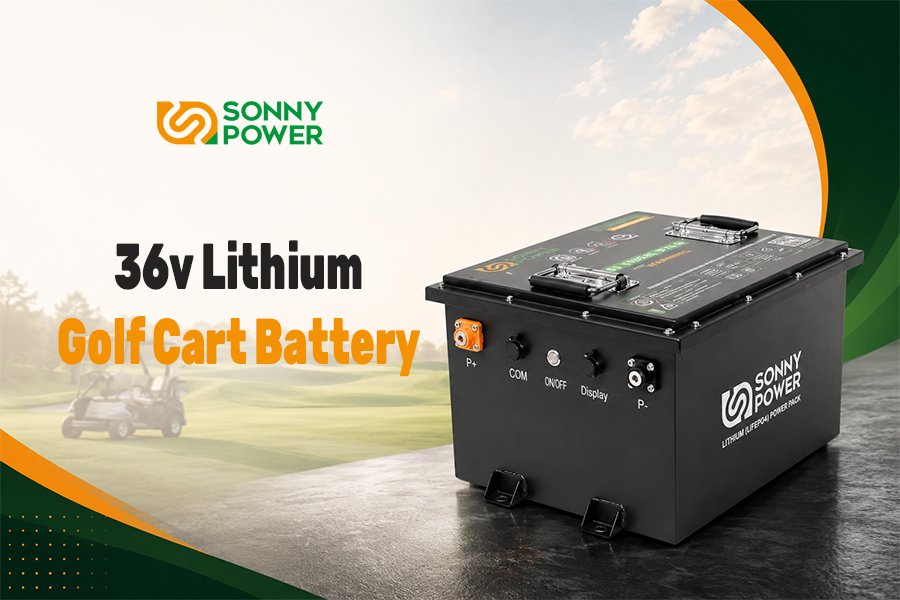
Older carts run 36 volts, and plenty of them still have decades of life in the frame and drivetrain. The batteries are usually what finally makes the decision.
Going lithium changes how a cart that age drives completely. It also brings more decisions than first-time buyers tend to expect, and getting a few of them wrong is easy enough.
36v Lithium Golf Cart Battery Capacity
Voltage sets how much power the motor receives. Amp-hours determine how far the cart goes before it stops.
The two get mixed up constantly. Put a 36V lithium golf cart battery rated at 105 Ah beside a 60 Ah pack of the same voltage, and both drive the cart the same way — one goes a lot farther before stopping. Working out what capacity actually suits comes down to honest use — a few holes twice a week needs far less than a neighbourhood runabout doing daily errands.
Terrain matters here too. Hills, heavy passengers and lift kits all drain packs faster than flat cart paths ever will.
The BMS Is Doing More Than You Think
Every decent lithium pack contains a battery management system, and the quality of that board separates good products from cheap ones.
It balances cells so none drift out of line. It cuts power before over-discharge damages anything. It blocks charging in freezing conditions and caps current draw under heavy load. Without it, cells degrade unevenly, and the pack fails years early.
Ask about continuous discharge ratings and peak output. A 36 volt lithium battery for golf cart use needs enough headroom to handle hill climbs and full loads without the BMS tripping out mid-slope, which is a genuinely irritating way to discover the spec was marginal.
Bluetooth monitoring has become common too. Being able to check state of charge, cell balance and temperature from a phone saves a lot of guesswork.
36 Volt Lithium Battery for Golf Cart Fitment
Old carts were designed around six lead-acid blocks sitting in a specific tray. Lithium packs are far smaller and lighter, which sounds like pure upside until the mounting question comes up.
Measure the battery bay before ordering anything. Check terminal orientation, cable routing and whether the existing hold-down hardware still works. Some kits include mounting brackets and adapters; others assume the buyer will fabricate something.
Weight reduction is dramatic — hundreds of pounds usually. That transforms acceleration and hill performance, though it also shifts the cart’s balance noticeably.
Warranty Terms Reveal Real Confidence
Ten years of coverage means a manufacturer expects the pack to still be working in ten years. That’s a much stronger signal than any spec sheet.
Read past the headline number, though. Find out whether coverage is prorated, what conditions void it, and how a claim gets processed if something fails in year six. Anyone comparing options should treat a 36v lithium battery for golf cart applications with vague warranty language as more expensive than the price tag suggests.
Cycle life feeds into the same calculation. Ratings past 3,000 cycles are normal for LiFePO4, with better packs pushing well beyond that. Against lead-acid, managing perhaps 500 to 1,000, the replacement maths stops being close.
Charger Compatibility Gets Overlooked
That old charger almost certainly won’t do the job. Lead-acid units run a voltage profile built around different chemistry, and months of that treatment damages lithium cells.
Check whether the kit includes a matched charger or whether that’s a separate purchase. Getting this wrong is an expensive mistake dressed up as a saving.
Installation and Support
Conversion involves more than dropping a pack in place. Cable sizing, terminal torque, charger matching and controller settings all affect how the finished cart behaves.
Sonny Power handles conversions across the Greater Houston area for a flat $400, with free pick-up and delivery — worth knowing for owners who’d rather not spend a weekend under the seat with a wrench.
Support after the sale counts as well. Lifetime technical assistance means somebody picks up the phone when a question comes up three years in, which is when questions tend to appear.
Buying a Golf Cart Lithium Battery 36v
Certification, safety testing and honest documentation separate serious manufacturers from the flood of unbranded imports. Data sheets, manuals and warranty registration all indicate a company operating properly rather than shipping generic cells in a plastic case.
A golf cart lithium battery 36v purchase made carefully lasts a decade and costs nothing in maintenance across that whole span. No watering, no equalising charges, no corroded terminals eating cables.
Take the time on capacity and fitment before committing. Those two decisions shape every ride afterwards, and neither one is easy to revisit once the money’s spent and the old batteries are gone.
Frequently Asked Questions
How far can a 36 volt lithium battery take a golf cart?
Capacity sets range, not voltage. Around 105Ah in a 36 volt lithium battery for golf cart duty usually gives 30 to 40 miles on flat ground. Hills, extra passengers and lift kits shorten that fast.
How often should a 36V lithium golf cart battery be replaced?
Far less often than lead-acid. Rated past 3,000 cycles, a 36v lithium battery for golf cart use typically runs a decade on recreational duty. Capacity slips gradually, so warning comes months ahead.
Can I use a 36V lithium battery in an older golf cart?
Yes, as long as the cart is already 36 volts. Older frames suit a golf cart lithium battery 36v conversion well — hundreds of pounds lighter, quicker off the mark. Budget for a matched lithium charger too.
